
Posture
Zazen is a practice involving the entire body-mind. Since mind and body are in fact not two, our physical posture has a profound effect on the entire meditation experience. Below are some examples of zazen postures, but the basics are the same no matter which position one takes.
First, we sit in an upright position, allowing a natural curve and gentle extension of the spine all the way up to the crown of the head. The head then “floats”above the spine as if suspended by a thread from the sky, with ears, shoulders, and hips aligned. The tongue rests on the palate behind the upper teeth, thus leaving breathing passages open. The body is firm but also relaxed—taut but not tense.
In zazen, the eyes are kept partially open, the gaze soft and relaxed. To minimize distractions, we generally sit facing a wall or other plain surface, without focusing on anything in particular in the visual field. One may allow the eyes to rest expansively, as if taking in a mountain range that fills the horizon.
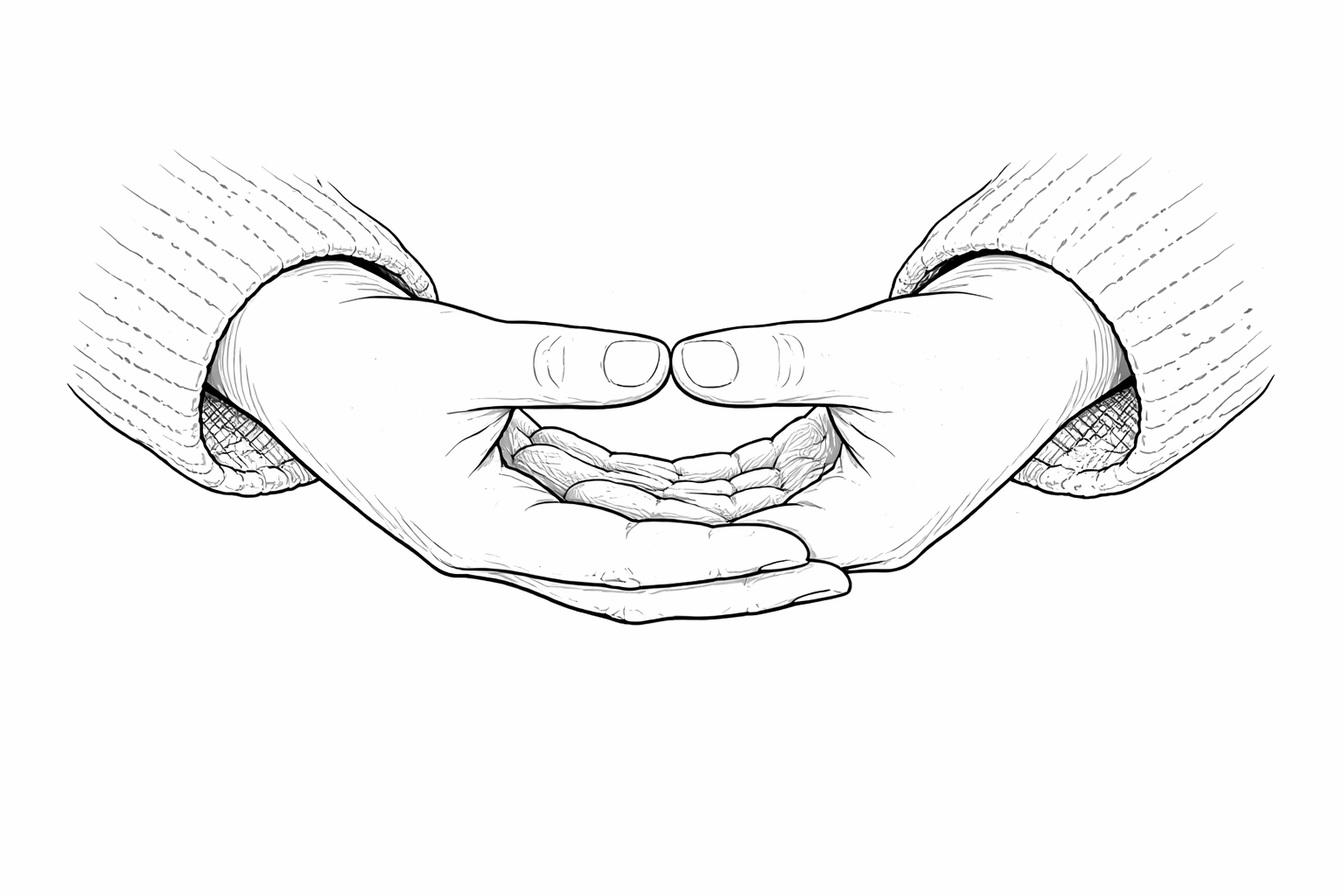
Hands are placed in the cosmic mudra: left hand resting in the right, palms open and facing up, fingers overlapping and thumb tips coming together gently over the palms, forming an open oval. The thumbs touch very lightly: as if holding a piece of paper without it falling out or being bent by the pressure. Another way to sense this: imagine holding a small bird—it would be neither hurt by your grip nor able to escape it.
The hands rest in front of the belly—the energetic center, or hara region—with thumbs at about the level of the navel. Unless one is sitting in a full or half lotus position, it can be very helpful to use a rectangular cushion to support the hands, so that the head and upper body do not tense up or lean forward.
Below you’ll find descriptions of different zazen postures. For clear illustrations of each posture, see The Three Pillars of Zen by Roshi Phillip Kapleau.We also go over posture in some detail during orientations and introductory workshops at Windhorse.
Introductory Zazen Instructions
-
Burmese
In the Burmese posture, one sits on a round zafu with both ankles on the mat, one in front of the other.
-
Quarter Lotus
In quarter lotus, one foot rests on the opposite calf.
-
Half Lotus
In half lotus, one foot rests on the opposite thigh.
-
Kneeling Positions (Seiza)
In Seiza, one kneels on a bench or a zafu that is turned on its side.
-
Sitting in a Chair
When sitting in a chair, one’s feet should rest flat on the floor. It is important to sit upright and not collapse back into the backrest. Support cushions may be used as needed to achieve the same taut but not rigid position as when sitting on a mat.
-
Full Lotus
In the full lotus position, one each foot is placed on the opposite thigh. This position is often unattainable or unsustainable for bodies raised sitting in chairs. It is not recommended for those new to practice and, for most people, must be worked toward slowly and with caution.
Zazen Practices
-
Counting the breaths from one to ten is usually the first practice recommended for those starting out in zazen. This is a very helpful aid in grounding and focusing the mind. This practice is not only for beginners: it can be a highly effective method for even advanced practitioners, especially at the start of a round or a block of sitting. Counting the breaths at the beginning of a round can help to cut through the web of thoughts that often follow people into a period of meditation—to prevent wasting precious time drifting about in whatever preoccupations may be hijacking the mind.
Although initially it may be helpful to count both the inhalations and exhalations, as the mind quiets down most people eventually switch to simply counting the outbreaths. Each exhalation joins with a number, going from one to ten; then we simply begin again at one. This practice helps to build concentration and stability, as there is clear feedback when concentration is broken (you may find, for example, that you are on a number well past ten, or have lost the count altogether). Breath-counting can also be a doorway to nondual meditation. One may find oneself “breathing the count” rather than “counting the breaths.”
Once you’re able to stay clearly focused on the count for a period of time, say 15 minutes, you may wish to shift to the practice of simply experiencing the breath. In this practice one’s entire being opens to the whole-body awareness of breathing. This includes everything within one’s sensory field: sounds, sensations, etc.—but with the breath-experience at the forefront of one’s attention. This is a merging, not observing, practice: one may find that there is only the breath breathing itself—that oneself, the breath and all things are one vibrant wholeness. The breath may become deeper and slower, even at times seemingly coming to a halt. All of this is the natural outcome of consciousness shifting to a deeper level.
-
At Windhorse, students may work on a kōan (KOH-ahn) under the guidance of a teacher. A koan is a question, statement, or brief story to be worked with in zazen and in dokusan (one-on-one interviews with a teacher). The spirit of each koan transcends logic, language, thought, and the dualism of subject-object, and must be demonstrated with one’s whole being. If you are interested in koan practice, it is best to speak about it with a teacher in dokusan.
-
Shikantaza translates as “just sitting.” This practice is most associated with the Soto school of Zen. In our lineage, which is an integration of Rinzai and Soto practice within a Western context, shikantaza is considered to be more than simply “open awareness:” it is seen as an advanced practice involving intensified boundless awareness beyond thought. At Windhorse this practice is generally taken up in the later stages of a person’s Zen life.